With a Second Farm in its Sights, AeroFarms Targets Next-Level Profitability
 September 24, 2025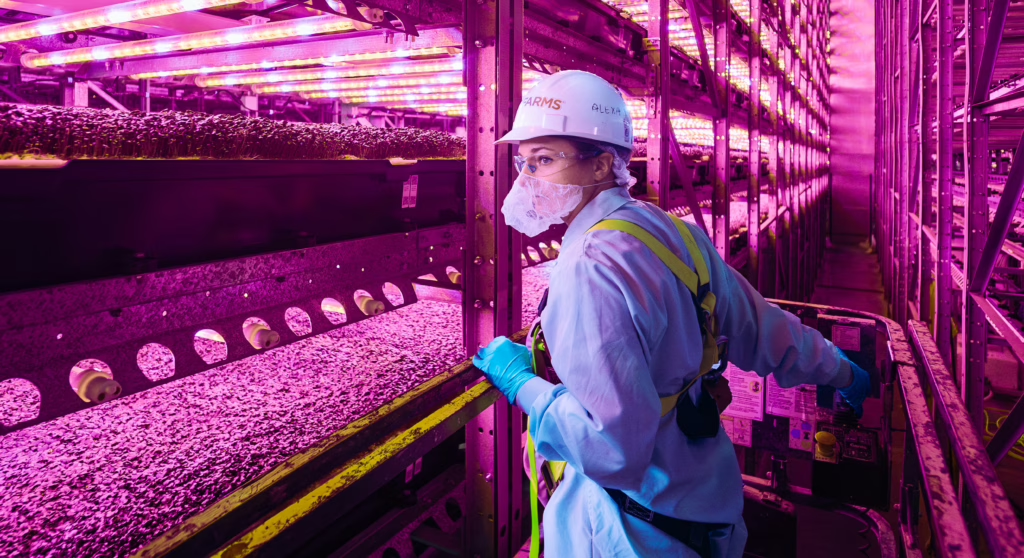
Photo courtesy of AeroFarms
It’s been a turbulent few years for aeroponics microgreens grower AeroFarms, long regarded as a pioneer in vertical farming. Like many investor-backed vertical farms, the company pursued rapid scaling before its commercial operations were fully established. It filed for Chapter 11 bankruptcy in June 2023 and emerged three months later with a new CEO/executive chair.
Under Molly Montgomery’s new leadership, AeroFarms shifted away from an R&D-driven culture to focus on revenue-generating operations, shutting down its Newark, N.J., and Abu Dhabi facilities in 2023 so it could focus its energy and resources on its Danville, Va., site. It beefed up automation at the 150,000-square-foot Danville farm to improve throughput and efficiency, allowing AeroFarms to continue delivering microgreens to customers such as Whole Foods. (It was the first vertical farm to ink a nationwide contract with the chain.) It also added a partnership with Costco shortly after Montgomery came on board.
Now, AeroFarms is getting ready to ramp back up, with plans in place to add a second farm dedicated to commercial-scale production. Having achieved three consecutive quarters of profitability at its Virginia facility, Montgomery says, “we’ve removed the technology risk and are bringing all our learnings from Danville to the new farm. We know it will work because it’s already working.”
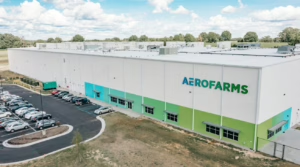
AeroFarms’ Danville, Va., facility. | Photo courtesy of AeroFarms
Major Interest in Microgreens
The location for the new farm has not yet been announced, though Montgomery says it will be “west of the Mississippi.”



“We are very near capacity in Danville, and yet we have unmet needs from our customers and consumers,” she says. In addition to Whole Foods and Costco, Harris Teeter, a supermarket chain in the Mid-Atlantic and Southeastern U.S., just added four AeroFarms products to the shelves across its 260-store portfolio.
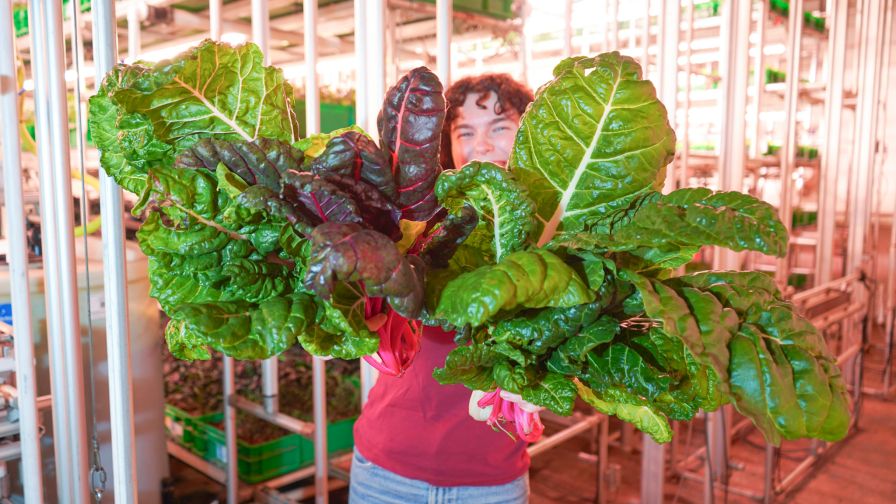
A number of factors are driving the market for microgreens in the U.S. today. Typically harvested 7-21 days after germination depending on the variety, microgreens are larger than sprouts but smaller than baby greens. They’re a nutritional powerhouse, offering four to 40 times the nutrients of their mature counterparts. For wellness-minded shoppers, that “superfood” status is appealing—and the growth of CEA has enabled microgreens to be more readily available in stores, fueling increased demand.
“Historically, of course, microgreens were only grown outdoors. And when you grow in soil and use pesticides, you have to wash the product,” Montgomery says. “Microgreens are very dainty. The second you wash them, the cell structure starts to break down, and their shelf life is only seven to 10 days.”
Indoor farming systems where the environment is fully controlled remove the need for washing and allow microgreens to be grown year-round, extending their accessibility. And aeroponic systems such as AeroFarms’, in which plant roots are suspended and misted with a nutrient solution (instead of sitting in water), are very well suited to microgreens, Montgomery says.
“Our shelf life is 21 days or more,” she explains. “We can get [products] through the retail channel and to consumers right where they already shop. It’s opened up a completely new category for microgreens.”
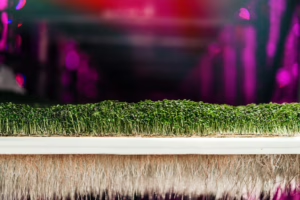
AeroFarms’ aeroponic system uses less water than other growing methods in CEA. | Photo courtesy of AeroFarms
Singular Focus
For AeroFarms, focusing solely on microgreens has made the most sense economically. “Our microgreens have a five-and-a-half-day growth cycle,” Montgomery says. “We run a facility 24 hours a day, seven days a week, 365 days a year. Our robots never stop.” At full capacity, the Danville farm is capable of producing over 3 million pounds of microgreens a year.
The company’s proprietary aeroponics technology, Montgomery adds, keeps the cost of production low. “We’ve built an extremely capital-efficient model. For example, our towers don’t have to hold water or soil since we’re just spraying the roots, so they don’t have to support extra weight. So we can build our towers higher, giving us more pounds per square foot of floor space.”
The aeroponic system also uses less water than other growing methods. “It’s a sustainability benefit, but it’s also a cost benefit,” Montgomery says.
The Ultimate Goal
As the industry waits for details on AeroFarms’ next move, its team continues to work on bringing operational costs down. “Our focus is on getting more and more efficient,” Montgomery says. “In the future, I think we’re going to be able to bring many other products to market at a lower cost and make those margins work.”
But first, they’ll have to replicate the success they’re having in Danville. Says Montgomery: “Long-term, success means profitability at the enterprise level. And what I love about our model is that to achieve that, we only need two farms.”