New Robot Pollinator Prototype Developed at Georgia Tech
 March 5, 2026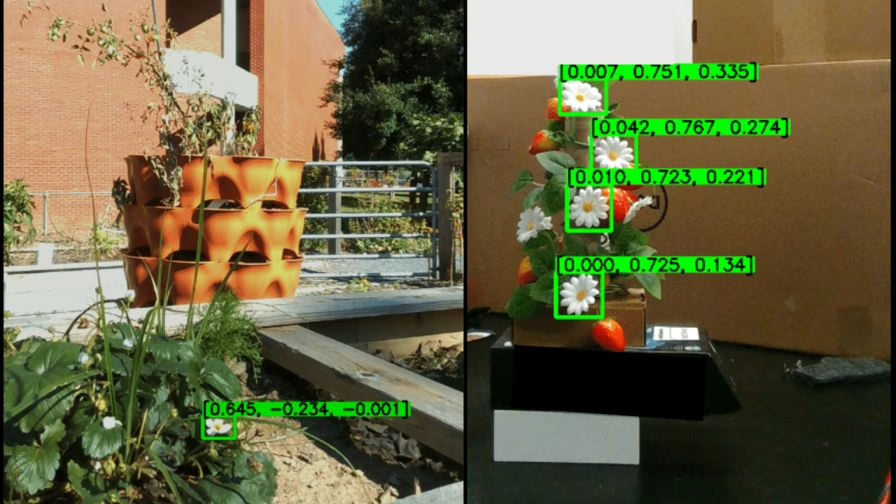
Photo: Georgia Tech Safe Robotics Lab
Vertical farms face a particular problem regarding pollination, as indoor facilities are inaccessible to natural pollinators (birds, bees, etc.) and therefore must be handled by human staff and equipment. This is an often tedious and labor-intensive process, but a critical one to ensure the success of each crop.
How the Robot Pollinator Prototype Works
Principal Research Engineer Ai-Ping Hu of the Georgia Tech Research Institute (GTRI), Assistant Professor Shreyas Kousik of the George W. Woodruff School of Mechanical Engineering, and a group of student interns have developed a robot prototype that aims to efficiently pollinate flowering plants and food crops in indoor farms. According to Georgia Tech, the prototype can “efficiently pollinate plants that have both male and female reproductive parts,” which require the transfer of pollen from one internal flower part to another, rather than to another flower entirely.
One early challenge, the team notes, was programming and teaching the robot to identify the “pose” of a crop, referring to its “orientation, shape, and symmetry.” This information is crucial, as knowing the anatomy and placement of a plant’s biological structures helps to speed up the pollination process and increase the chance of reproductive success.
Harsh Muriki, a robotics master’s student and past intern for Hu and GTRI, improved identification of the pose by attaching a camera to a FarmBot to collect images of strawberry plants during the bot’s work watering and spraying pesticides. Using this collection of images, Muriki and the team created a 3D model, converted to 2D for faster processing, for the pollinator prototype. Ved Sengupta, a computing engineering major, then used the YOLO (You Only Look Once) detection system to identify and classify objects.
Together, Sengupta, Muriki, and Hu co-authored a paper based on their work that was accepted by the 2025 International Conference on Robotics and Automation (ICRA) in Atlanta.



Beyond pollinating, the prototype is also capable of analyzing a crop and determining “how well it was pollinated and whether the chances for reproduction are high.”
For more information about the robot, read the full article from Georgia Tech and visit the Safe Robotics Lab project page.