Expert Roundtable: What Urban Farming Got Wrong

 December 22, 2025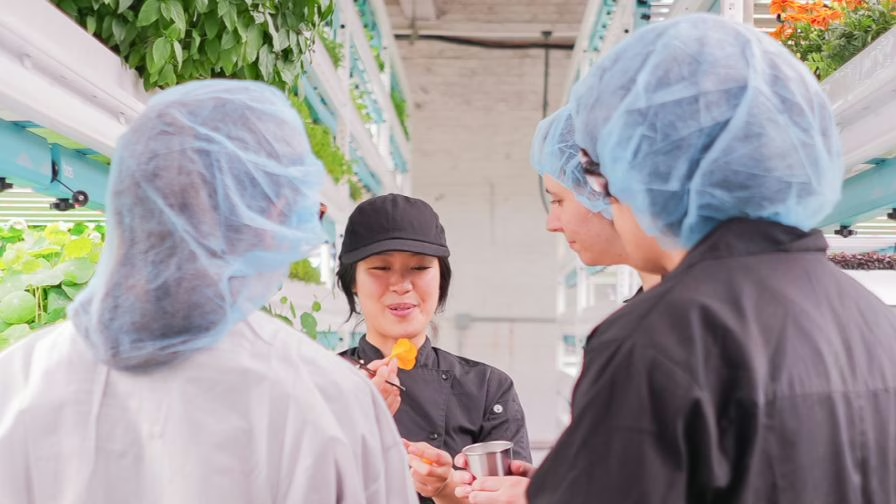
A Farm.One grower harvesting microgreens and edible flowers. | Photo courtesy of Farm.One
One of CEA’s biggest selling points is its potential to bring fresh, healthy, locally grown produce into areas that otherwise don’t have enough land or the appropriate climate for farming. That includes densely populated cities—and while some countries (e.g., Singapore, Japan) have demonstrated relative success with indoor urban farms, progress has been challenging elsewhere.
The white whale of profitability is a big part of the difficulty. Urban real estate and energy costs are expensive; permits, proper infrastructure, and logistics can be tricky. The U.S. doesn’t have the same level of government subsidization as some other countries for these kinds of endeavors, either, while investor interest worldwide has cooled considerably.
There are rare bright spots: Gotham Greens remains the poster child for successful U.S. urban farming, having expanded dramatically since its first greenhouse launched in Brooklyn in 2011. But it may be the exception that proves the rule. As the company has scaled, most of its facilities have been built in suburban and rural areas across the country.
For truly urban greenhouses and vertical farms, the parameters for success may need to change. Whether it’s a community rooftop garden, a small-scale vertical farm, or an industrial warehouse, urban farming still holds vast promise for the future. To find out more, CEAg World’s Dana Shugrue reached out to a group of CEA players with diverse experience and insight into urban farming (see sidebar for details) for the roundtable discussion that follows.
CEAg World: Let’s talk about how things have evolved in urban indoor farming. Where do you feel mistakes were made, and is there a path to success?
Henry Gordon-Smith, Agritecture: Especially in the vertical farming context, we continue to see an obsession with technology. [What they’re building has to] function as a farm, but in reality they’re just trying to sell their tech and create value for it.


I got to tour Local Garden in Vancouver, the first commercial urban farm in North America, when it was first starting out. They missed the mark right out the gate: They were growing leafy greens just to prove their tech worked for a bigger market and ended up going bankrupt in a year and a half. This served as a cautionary tale for me, and I keep seeing the same mistake being made over and over again.
Adrienne A. Wilson, Feed Our Soul: I founded Feed Our Soul in 2018, and I was going to make money by selling greens, because that’s what everybody was doing. But after years of working in different spaces and going to conferences, I realized [we had to solve] the labor issue. How do we teach people how to grow and manage technology on these farms?
You need to have someone in your community who knows how to do agriculture, because who knows when, you know, the next pandemic will happen. These hard skills are becoming less and less accessible. So I turned my organization into a nonprofit and started focusing on the educational piece.
Meg Burritt, Planted Detroit: Adrienne, what made you decide to build your own indoor farm instead of partnering with an existing one and bringing your educational skill set there?
Wilson: One, I felt like I had to do it myself if I was going to teach people. I wanted to be a grower for so long, to get my hands into it physically. And two, I didn’t really find anyone in our local economy. There was one, but it was about two hours away from the city limits. I wanted to focus on that local piece, to make sure it’s accessible to the Black and Brown community.
Burritt: You raised a good point: Should some of these businesses be structured as nonprofits, while others are pure agricultural ventures or tech companies? Many of these CEA businesses see the writing on the wall about failure, then pivot to trying to sell their tech. I think people are making that switch because they don’t know how to effectively grow leafy greens at scale to become profitable.
Gordon-Smith: I thought rooftop greenhouses were interesting, but they basically just didn’t succeed. They were integrated into buildings that were driving new forms of development and sustainability that I found fascinating—like Sky Vegetables, where they used waste heat to heat the plants and they’d capture rainwater.
But the scale matters so much in greenhouses that you couldn’t do it. The CapEx is so expensive for rooftop greenhouses that the vertical farm makes more sense. But I was sad to see [many rooftop greenhouses fail]. In the end, I hope it can still have a meaningful impact.
Derek Pitts, Farm.One: We grow high-end microgreens and flowers for the fine dining scene in New York City. When I think about these crops from a business perspective, they’re probably the best ones to grow in a vertical, urban farm format. They aren’t shippable unless you want to pay overnight shipping and expand your carbon footprint.
To me, the key is figuring out what your market is and how to attack it sustainably. I focus on growing microgreens because high-end restaurants in urban areas like ours can’t get enough of them and I make it easy to buy them. Growing something your consumers want, getting it to them as soon as possible, and delivering it at a higher quality without burning a lot of fuel in the process is a win in my book.
What are the biggest opportunities for urban farmers right now?
Wilson: People from the farming and hospitality sides of the industry are connecting to build a network in the agricultural space. I’ve seen small bodegas sell produce from urban vertical farms and community gardens to make it more accessible to Black and Brown communities. In metropolitan L.A., where food is getting more and more expensive, it’s important for everyone to have access to fresh, healthy, local food. Urban farming is a pathway to that.
Gordon-Smith: There’s a unique window where we have still have enthusiasm. New entrants are coming in. I still believe urban farming is part of a wider climate change adaptation solution, which is what I’m passionate about.
I want to get real data and proven business models out there, giving us a chance to adapt to the inevitable, intense shocks to our food system that are coming. We want to diversify the crops that work. We want a range of models that are proven to be fundable. We want to have talent that can feed into that.
Burritt: I fully agree about resiliency. I’m also thinking about how we need to right-size our food system to better match both consumer demand and our farms. Even though we’re specifically talking about urban farming’s financial challenges, agriculture as a whole has faced its own financial challenges. We need to think about where we put the different pieces of the puzzle and better serve consumers so our outdoor farmers can keep their lights on at home, too.
Pitts: You’d be hard pressed to find anyone anywhere, including urban areas, who wouldn’t agree that we’re on the right path; I’ve never run into anyone who’s against healthy eating. I see the market and that’s one of the most motivating opportunities.
It’s not about convincing people that they should be doing what you want to do. If you can find a way that they can do it conveniently, you’ll be flooded with that kind of opportunity.
Meet the Panelists
Meg Burritt, Ph.D. Candidate at Michigan State University; former COO, Planted Detroit
Meg Burritt’s studies are currently focused on economic solutions to horticultural challenges in CEA. They’re a seasoned food industry strategist passionate about food systems and eradicating food insecurity through market innovation. They have over 15 years of experience in strategy and business development at organizations from grocery stores to produce distributors to farms, including Planted Detroit—a vertical farm in Detroit’s Islandview neighborhood.
Henry Gordon-Smith, Founder and CEO, Agritecture
Henry Gordon-Smith is a globally recognized expert in climate-smart agriculture and a pioneer in the vertical and urban farming movement. With more than 10 years of experience, he advises governments, real estate developers, startups, and NGOs on how to design and scale sustainable food systems for cities and regions. He has consulted on projects in more than 40 countries and visited urban and CEA farms across five continents, giving him firsthand insights into what drives success in diverse contexts.
Derek Pitts, Founder and CEO, Farm.One
Derek Pitts is a seasoned executive with experience in finance, management, and corporate strategy across various sectors. In addition to helming Farm.One, a 10,000-square-foot vertical farm in Brooklyn that supplies local chefs with specialty greens, herbs, and edible flowers, he’s the founder and managing partner of DK-Bell Holding Co., focusing on strategic acquisitions in the food and ag tech sector.
Adrienne A. Wilson, Founder and President, Feed Our Soul
Adrienne A. Wilson is a chef, educator, and community advocate who believes everyone should have the knowledge and tools to grow and cook their own food. Through Feed Our Soul, she leads programs that install community gardens, teach hands-on cooking skills, and design food experiences that strengthen the relationship between people, culture, and the environment. She has more than a decade of hospitality experience and degrees from Carnegie Mellon University and Georgetown University.
Editor’s note: This article was originally published in our 2025 Industry Report: State of the CEA Industry.