What Does Outdoor Protected Ag Look Like Today?
 October 1, 2025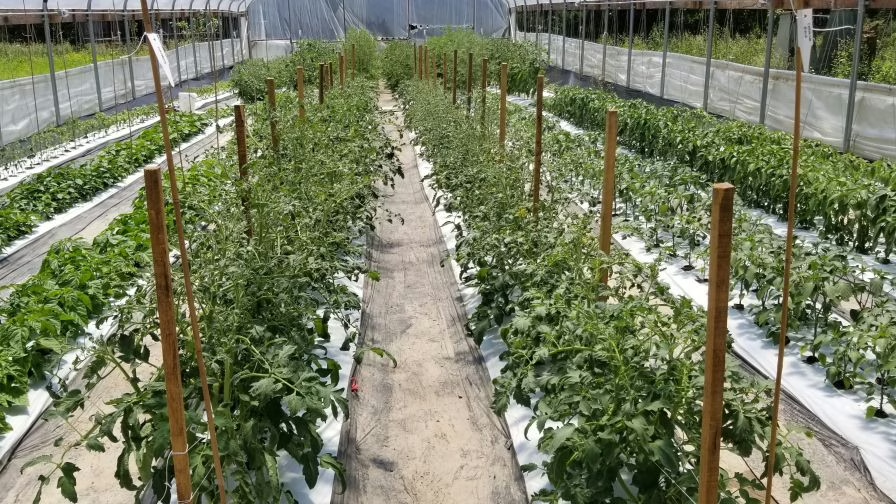
In our Industry Report: Protected Crops, we provide a snapshot of the state of protected cropping efforts on U.S. farms today. | Photo courtesy of Sandy Dwyer
As the agriculture industry continues to evolve, many growers have started using ag tech and protected cropping systems to alleviate common pain points in outdoor field production.
In the 2025 State of the Vegetable Industry Survey from CEAg World sister brand American Vegetable Grower (AVG), growers shared information about how and why they use ag tech and protected cropping systems. Their responses also shed light on the most notable challenges growers are facing, and why they think these tools help streamline production on their farms.
We’ve compiled these insights, along with a firsthand perspective from grower and survey respondent Sandy Nelson from Box Turtle Ranch in Camdenton, Mo., to provide a snapshot of the state of protected cropping efforts on U.S. farms today. Nelson grows cucumbers, tomatoes, bell peppers, and sweet peppers on her farm in two high tunnels.
Notable Findings
Since USDA considers produce a specialty crop, it devotes less funds to gathering information on vegetable production. By surveying 598 growers, suppliers, researchers, and other industry professionals across the U.S. in February and March 2025, AVG gathered important intel on labor, production, and other key trends that could have gone uncaptured.
Of the 162 respondents that use protected cropping systems, a large majority (82%) said they did so in order to extend their growing season. Box Turtle Ranch’s Nelson is one of them.



“I’ve added two months to the back end of my season,” she says. “I now have tomatoes growing into October and November when I normally would have to stop growing in August.”
The crops grown the most under cover by respondents include tomatoes (39%), peppers (33%), and leafy greens (32%)—not surprisingly, as these vegetables are among the most widely grown across the CEA spectrum.
Pain Points Ag Tech Can Iron Out
While less than half of the growers who participated in AVG’s survey use protected cropping systems, 82% use or are interested in using ag tech in their operations. The top three factors that drove respondents to implement technology include: increasing efficiency on the farm (63%), improving crop quality (46%), and supplementing their lack of labor (34%).
These are three key areas that often attract growers to the CEA industry. By leveraging technology, greenhouse growers and vertical farmers have been able to eliminate repetitive, time-consuming tasks from their daily work. Not only does this help with labor, but it also improves efficiency on the farm and produces higher quality crops. With more time in their day, growers can accomplish more tasks and shift their focus to growing more flavorful, nutrient-dense crops.
While she doesn’t use ag tech currently, Nelson believes that she would if she grew in more than two high tunnels. “I don’t have a need for it right now,” she says. “I think I would go for ag tech if I had 30 high tunnels or more so that I could keep track of everything.”
According to AVG’s survey, outdoor growers tend to use low-tech hoop houses and high tunnels (40%), low tunnels (27%), and high-tech greenhouses (25%) to protect their crops. | Photo courtesy of Sandy Dwyer
Leaning Low-Tech
Despite CEA’s high-tech reputation among some, AVG’s survey responses reveal that many vegetable growers that use protected cropping systems lean low-tech. Three protected cropping systems that stood out among the growers surveyed: low-tech hoop houses and high tunnels (40%), low tunnels (27%), and high-tech greenhouses (25%).
This means approximately 67% of the protected ag growers surveyed use low-tech tunnels and hoop houses to protect their crops. With high tunnels ranging in price from $1 to $2 per square foot and low tunnels ranging from $0.50 to $1 per square foot, it presents an affordable alternative to growing fully indoors. Considering 62% of the growers surveyed view ag tech as too expensive to implement in their operations, hoop houses and high tunnels present a reasonable first step for entering the CEA space.
“There needs to be more marketing for outdoor growers to use high tunnels,” Nelson says. “Because you can grow a lot of food in a high tunnel, no matter where you are. I’m proving that you can grow food in the middle of the woods in the Ozarks.”
As outdoor field production becomes more challenging, growers are turning to ag tech and protected cropping systems to simplify their day-to-day tasks. When AVG conducts its 2026 SOI survey, it wouldn’t be surprising to see the percentage of protected ag growers increase—and based on this year’s data, those who decide to dip their toe into CEA will likely do so with a hoop house, high tunnel, or low tunnel.
Editor’s note: This article was originally published in our Industry Report: Protected Crops.