Research Brief: Using Nutshells as a Growing Medium in Decoupled Aquaponics Systems
 July 22, 2025
Photo: Traders Hill Farm
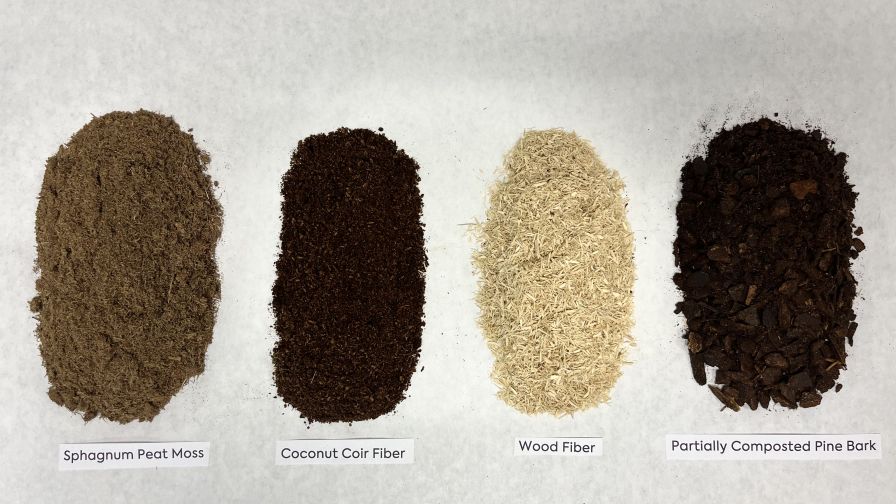
Coconut coir is widely used as a soilless growing medium, but it comes with a price. The substrate is shipped thousands of miles from tropical regions, forcing growers to deal with high salt content that requires extensive washing and rising transportation costs.
Meanwhile, U.S. nut producers are generating over 1.2 million tons of shell waste annually that typically gets burned or sent to landfills.
Recent research at the University of California, Davis (UC Davis) has explored whether walnut and pistachio shells could replace coconut coir as a substrate that’s more beneficial for CEA growers.
The researchers put the shells to the test in a decoupled aquaponic system, growing Genovese basil in a greenhouse. They compared different inclusion rates (10%, 25%, 33%, and 50%) of both nutshell types against coconut coir and a standard peat/perlite control.
Key Findings for Growers
When they used walnut shells, the researchers found that their plants grew slower at the start due to juglone (a natural compound in walnut shells). By week four, the growth rates matched those from coconut coir treatments. In addition, they found that 25% inclusion gave the best balance of performance and sustainability and that crushed shells worked better than whole shells.


With pistachio shells, the researchers found that between 10-33% inclusion rates performed similarly to coconut coir. On the flip side, more than 50% inclusion reduced plant growth significantly. In their research, it also appeared that whole pistachio shells created drainage issues and restricted root development, while the high concentrations of natural phenolic compounds in the shells became toxic for plants.
Ultimately, walnut shells show promise as a coconut coir substitute, especially with 25% inclusion rates. The initial juglone effect wears off, and growers can get comparable yields with a locally sourced material. While pistachio shells can work, they need more processing. Their large, rigid shells create water management challenges that could impact irrigation efficiency.
Why This Matters for CEA
Using walnut and pistachio shells offers several environmental and economic benefits for CEA growers. If implemented in their operations, growers could reduce transportation emissions by using local waste, turn agricultural waste into valuable inputs, and put less work into washing or buffering their growing media (a time-consuming task for coconut coir).
In addition, growers could save money by not using imported materials and using less water to prepare their substrate. Before they fully adopt this substrate, however, they would need to start with a 25% inclusion rate test in their current system and work with suppliers to ensure they get shells of the same size and composition.
The UC Davis researchers recommend keeping inclusion rates at or below 33% until processing methods improve. Future studies will likely focus on developing treatments that reduce compounds that are harmful to plants, creating an ideal particle size for better water retention, and optimizing processing methods for commercial viability.
The full research findings can be found on the Frontiers in Horticulture website here: https://www.frontiersin.org/journals/horticulture/articles/10.3389/fhort.2025.1486312/.