Key Parameters for Finalizing Your CEA Lighting Plan
 September 8, 2025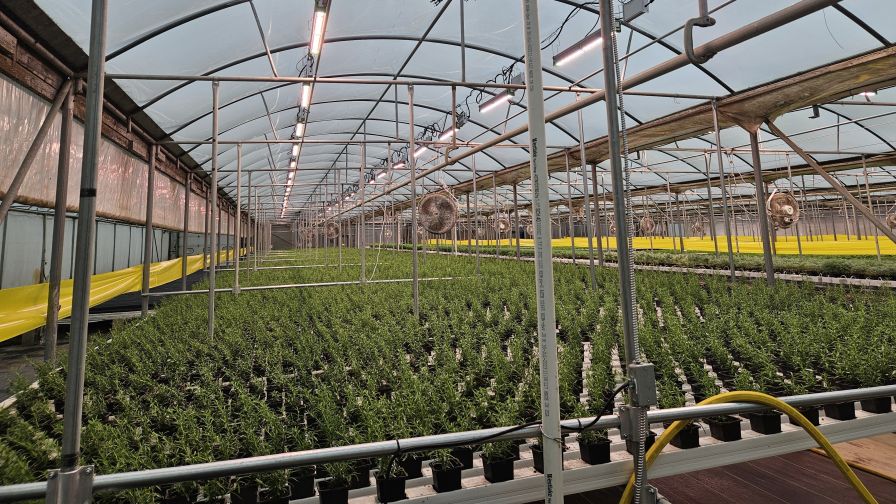
Using essential lighting quantifications and strategic planning factors will help you choose the right lighting plan for your CEA facility. | Photo: TotalGrow Lights
In my last two articles, I explored how essential lighting quantifications and strategic planning factors drive successful projects. Now it’s time to put these pieces together in a practical planning methodology. The TotalGrow DIY Lighting Calculator walks you through this process systematically, helping you input key parameters to see how different decisions impact your lighting plan firsthand.
1. Define Your Growing Parameters
Start by clearly defining your crop category, growth stage, environment type, and overall lighting goal (maximum impact, minimal cost, or a middle balance) in the calculator. Different crops have dramatically different daily light integral (DLI) requirements—lettuce needs roughly 10-17 mols of light per square meter per day (mol/m2/day), while tomatoes require between 20-50 mol/m²/day.
Your environment fundamentally affects every decision you make. Sole-source indoor operations need higher intensities and uniformity than greenhouse supplemental applications where sunlight meets much of a plant’s lighting needs.
For example, on one of our recent projects with a greenhouse herb grower, we established that a high (optimum) lighting target fit their business goals for a target DLI of 17 mol/m2/day. Their greenhouse receives ~5 mol/m2/day during their Michigan winters, requiring ~12 mol/m2/day of DLI from LED lights.
2. Calculate Light Requirements
The DIY lighting calculator translates your goals into specific targets. Input your target DLI, subtract available natural light, and choose your photoperiod to determine required photosynthetic photon flux density (PPFD).


For the greenhouse herbs project, the lights can run for up to 18 hours per day. Providing 190 µmol/m2/s PPFD light intensities for 18 hours accumulates to the 12 mol/m2/day DLI needed to meet their growth goals.
3. Factor in Strategic Constraints
Input your strategic constraints—physical space dimensions, mounting height, and budget priorities. Available height determines fixture selection—more height allows fewer, more powerful lights while limited height requires more fixtures for uniform distribution.
Budget considerations balance initial costs against operational efficiency. Seasonal operations often benefit from lower-cost, standard-efficacy fixtures, while year-round facilities can consider higher-efficacy options.
The herbs greenhouse we worked with had relatively low available heights at six feet from crop to fixture, requiring lights to be a maximum of 12 feet apart to maintain uniformity. However, they had a relatively high target intensity, which requires a higher concentration of light fixtures than the 12-foot maximum spacing. They also had the added benefit of a utility incentive and financing program that made it easier to budget for a top-end lighting intensity in their plan as long as they minimized the upfront cost per watt.
Ultimately, 660-watt, 2.6 micromoles per joule full-spectrum LEDs nine-foot centers throughout their 18- by 156-foot bays allow them to maintain summertime production quality and yields every month of the year. Light sensors and controllers dim and brighten the lights automatically to maintain the target intensities while minimizing wasted power.
4. Equipment Selection and Validation
The calculator recommends appropriate fixtures based on your inputs. It shows required quantities, suggested layouts, and expected performance, including intensity and energy consumption.
Review the energy costs section of the calculator to understand ROI timelines and compare different efficacy options. Factor in available utility incentives, which can dramatically improve project economics. Quality lighting providers will support you in exploring these incentive opportunities, which are starting to phase out as more states treat LEDs as the assumed lighting solution. Growers considering lighting projects would be wise to learn whether they have helpful incentive programs available and pursue project approvals before these programs become less helpful.
Guidance for Optimal Results
While the DIY lighting calculator provides helpful initial planning, every operation has unique challenges and opportunities. You can choose to submit your calculator results to us at TotalGrow to refine your plan for maximum efficiency, utility incentive programs, and address specific constraints like existing infrastructure or future expansion plans. We’ll provide detailed specifications, installation guidance, and ongoing support.
This systematic approach—from basic quantifications through strategic planning to expert consultation—ensures your lighting project optimizes both plant performance and business outcomes.