Spectral Tuning in CEA: When Complexity Serves Your Crops
 May 6, 2026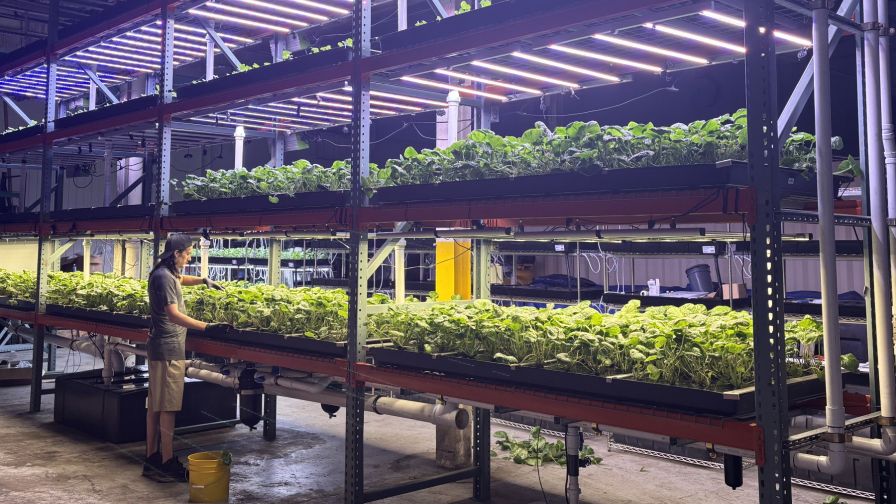
Cai Foods in New Buffalo, Mich., grows wasabi plants under TotalGrow LEDs. | TotalGrow
Growers are facing contradictory advice from lighting manufacturers about spectral tuning. You can find a dozen different lights offering various tuning capabilities, each claiming that theirs is essential for optimal growth. But growers need to consider whether any particular level of spectral control actually serves their specific operation.
The Three Levels of Spectral Control
Understanding your options helps clarify what matches your needs versus what adds unnecessary complexity and costs.
Fixed Spectrum: Simple and Reliable
Most greenhouse growers and basic indoor operations succeed with fixed-spectrum lighting. These systems provide proven results at lower costs with nothing to manage incorrectly.
Fixed spectrum works best when growing large crop varieties in overlapping areas where tailoring spectrum becomes impractical, when you value simplicity and reliability, have tight budgets, or grow a single crop type where you can select an optimized fixed spectrum.
For operations with diverse crop types, a balanced, red-emphasis, full-spectrum driving natural morphologies provides safe, effective, maximum-versatility results.


Basic Tunable: Flexibility Without Extreme Complexity
Growers wanting flexibility without overwhelming complexity benefit from 2-4 channel systems. These typically feature a balanced primary spectrum with additional channels for quality enhancement (blue/UV), quantity enhancement (far-red), and/or efficiency optimization (deep red).
Basic tunability helps you adjust for different crops, growth stages, or seasonal natural light variations. It allows morphological modification and provides R&D capabilities to trial different spectra and guide future lighting choices.
A smart strategy for those with time and space as their operation develops is setting up a smaller R&D section with tunable spectrum lights. Test different spectra, see which best meets your goals, then use that knowledge to pick the most cost-effective, targeted, fixed- or basic tunable-spectrum light and intensities in a larger-scale build-out.
This approach works best with limited crop variation, high control of other environmental conditions, consistent genetics, and adequate capital budgets. However, it requires understanding spectral impacts and the technical savvy to adjust strategies based on complex interactions between environmental conditions.
An 860W, 3-channel LED grow light with a balanced primary full spectrum and independent UVA and far-red channels exemplifies this category, giving growers spectral flexibility without overwhelming complexity.
Advanced Multi-Channel: Research-Grade Precision
Research operations and highly specialized growers utilize 5+ channel systems with independent control over UV, blue, green, amber, red, far-red, and/or white wavelengths.
This level provides precise control over every light quality aspect, essential for research requiring specific conditions or operations pursuing novel crop responses. However, most commercial operations won’t utilize this control level. Less common LEDs, like UV and green, are typically far less efficient and more expensive.
For this category, customized solutions such as a 3000W, 8-channel research light can provide virtually any intensity and spectrum imaginable, though with substantial costs/variability.
Understanding Tunability Specifications
Not all tuning is created equal. Sometimes tuning works by simply turning down/off some LEDs, so the total light output decreases from maximum while increasing the spectral percentage of the remaining LEDs. This typically means fixtures should be capable of providing excessive light levels, so tuned settings with reduced output remain strong enough.
More expensive designs have enough LEDs to maintain full power while transferring power between different colored diodes. This provides better working flexibility but may not justify extra costs for all operations.
It’s often difficult to find quantification of a light’s actual tunability. What are the minimum versus maximum amounts of each channel? If a light can only adjust 1–2% of UV, blue, or far-red, the impact will be quite small and serves more as marketing than a genuine growing tool. Tunability of 3–15% of these photomorphologically manipulative regions is a far more useful tool.
Five Questions to Guide Your Decision
1. What Are You Growing?
A small variety of crops or growth stages makes basic tuning worth considering. Monocrops may be maximized with a focused fixed spectrum. Diverse crops likely need a broad, fixed spectrum. Research and novel operations may justify advanced control costs.
2. What Are Your Quality Goals?
Standard production succeeds with proven fixed spectra. If secondary metabolite enhancement (flavor, potency, coloration) significantly impacts market value, tuning may add measurable value. Precise research parameters necessitate advanced systems.
3. What’s Your Technical Capacity?
Limited staff benefits from simple systems, reducing operational burden. Experienced growers with available time can leverage tuning as optimization. Consider staff turnover. Complex systems require institutional knowledge that may be lost with personnel changes.
4. What’s Your Budget Reality?
More channels mean higher upfront costs plus more complexity to manage. Honestly assess whether improvements will justify complexity costs and consider ROI timelines realistically.
5. What’s Your Environment?
In greenhouses, spectral changes are less influential since natural sunlight dilutes LED spectral impacts. Sole-source indoor environments, including vertical farms, experience strong spectrum effects with greater predictability, plus a faster ROI from efficiency investments.
The Modular Alternative: Instead of built-in multi-channel lights, consider modular approaches using fixed-spectrum primary lights, and add the desired intensity of far-red or blue/UV complementary lights only where beneficial. Pay for complexity only where it adds value.
The Spectral Truth
Most commercial growers succeed with strategic, fixed solutions, with growing consideration for basic tunable solutions. Advanced multi-channel control serves specific research applications beautifully, but buying capability you won’t use adds cost, complexity, and potential failure points.
Don’t let industry buzz override fundamentals. Light quantity (DLI) matters more than perfect spectra. Uniformity and reliability trump fancy features. The interactions between spectrum, nutrients, airflow, genetics, and intensity are complex. Adding spectral variables without controlling other factors often creates confusion, not optimization.
The best system matches your actual goals and capacity. Partner with manufacturers offering the full range, so recommendations come from an honest assessment of your needs rather than being limited to a single solution.