Indoor-Grown Strawberry Young Plants Show Commercial Promise in New Trials
 March 4, 2026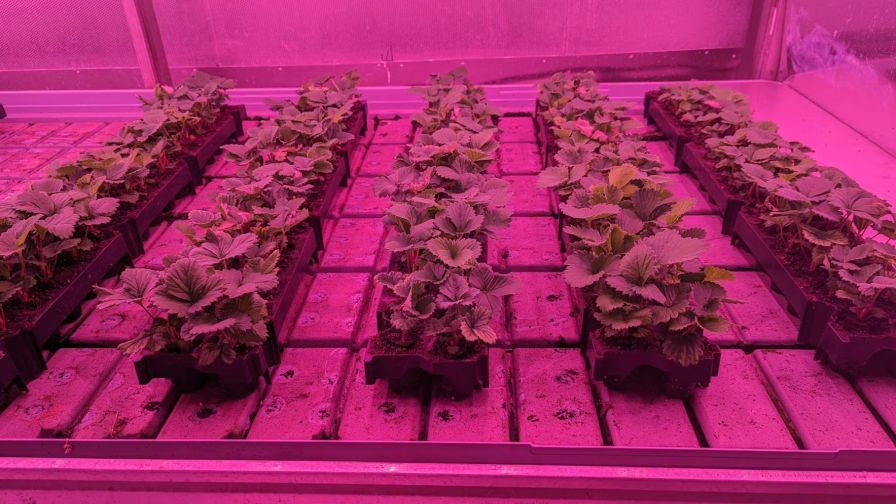
Photo: Signify
Indoor production of young strawberry plants is moving beyond experimentation and into commercial relevance, according to new trial results shared by Thijs van den Bergh, Plant Specialist at Signify, in a recent company blog post.
Conducted in collaboration with partners Limgroup and Artechno, the trials examined whether seed-grown F1 hybrid strawberry plants raised entirely indoors could outperform conventionally propagated starting material.
The work builds on long-term shifts in European strawberry production, particularly in the Netherlands, where output has increased without major acreage expansion thanks to tunnels, greenhouses, and advanced climate and lighting control. The trial focused on production-oriented F1 hybrids such as Limore 1 from Limgroup, evaluating how indoor propagation protocols affect plant development and downstream greenhouse yields.
Faster Propagation Cycles with Fully Controlled Indoor Growing
One of the most notable findings was speed. In a fully controlled environment, flowering young plants were produced in about 10 weeks, compared with roughly 16 weeks in a lit greenhouse, cutting propagation time by more than 30% and enabling year-round scheduling independent of outdoor seasons.
Lighting Spectrum and Intensity Drive Yield and Early Harvest Timing
Lighting strategy proved critical but not extreme. Trials testing varying levels of blue, green, and far-red light showed that moderate light intensity — around 180 μmol m⁻² s⁻¹ — combined with 12% to 18% far-red light promoted earlier and more uniform flowering. Higher intensities produced heavier plants but did not translate into higher fruit yields later, underscoring the importance of balance rather than maximum light input.


In greenhouse benchmarking, indoor-grown young plants delivered around 40% more fruit over the production cycle and entered harvest roughly two weeks earlier than conventionally propagated plants. According to van den Bergh, the combination of faster cycles, higher yields, and clean, chemical-free starting material positions indoor-grown F1 young plants as a technically feasible and commercially compelling option for modern strawberry production systems.