Real-Time Plant Feedback Drives Big Gains in Autonomous Tomato Trial
 December 1, 2025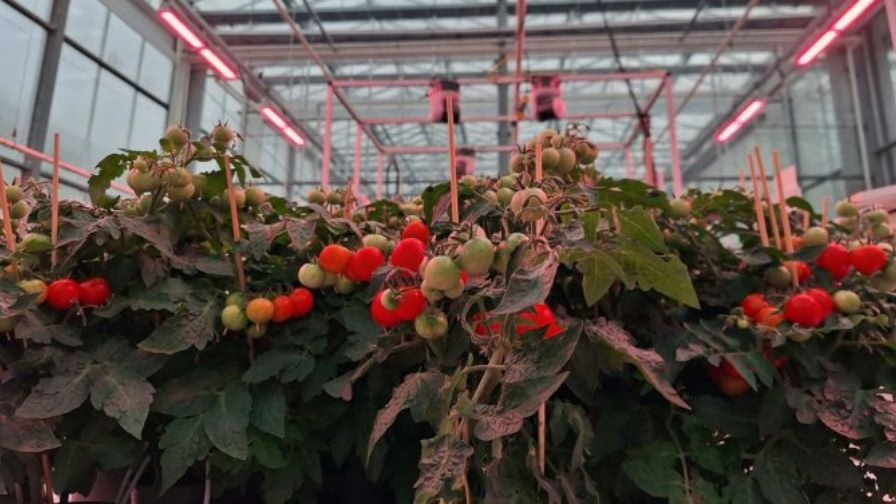
The cultivation of dwarf tomatoes during the Autonomous Greenhouse Challenge. | Wageningen University & Research (WUR)
A team competing in Wageningen University & Research’s latest Autonomous Greenhouse Challenge reported substantially higher tomato yields and stronger profitability by using continuous plant-feedback data to guide greenhouse decisions. The results offer a look at how real-time physiological measurements — rather than environmental conditions alone — could shape the next generation of greenhouse automation.
Team MuGrow, a collaboration between TU Delft, Gardin, and Rijk Zwaan, managed its greenhouse compartment entirely autonomously from potting to harvest, as required by the competition. Using dwarf cherry tomatoes, the team achieved the highest yield per pot and the shortest crop cycle of the competition. Their system produced 44 kilograms per square meter annually — about 9 pounds per square foot, or roughly 396,000 pounds per acre per year. This represents a 30% improvement over the challenge’s reference grower and exceeds typical commercial benchmarks for comparable tomato crops.
Using an assumed price of €2 per kilogram (about $0.98 per pound), the team calculated that its approach generated an additional €200,000 per hectare per year, equal to approximately $86,000 per acre per year in added crop value compared with the reference scenario. Profitability increased by 35%, with potential gains reaching 60% if harvest timing constraints had been more flexible.
Researchers attribute much of this performance to biofeedback from chlorophyll-fluorescence sensors, which measure photosynthesis in real time. Rather than relying solely on set points and climate proxies, the algorithm adjusted lighting, temperature, and CO₂ based on how the plants were actually responding. According to the team, this helped navigate the complex relationship between weather, greenhouse climate, and plant behavior — one of the most challenging parts of autonomous control.

While the algorithm itself was developed for research purposes, the underlying sensor technology is already being used in commercial greenhouses. Gardin’s four plant-indicator metrics — health, balance, efficiency, and productivity — are designed to help growers understand crop stress, source, sink balance, light-use efficiency, and daily photosynthesis. Researchers say the competition’s results reinforce that direct plant measurements could play an increasingly important role in both assisted and fully autonomous crop management.