Researcher Insights: Top Growing Media Tools and Trends for Growers
 November 17, 2025
Vijay Rapaka, Ph.D, Director of Global Grower Operations and Research, Oasis Grower Solutions
No factor is more critical in the success of a growing operation than your choice of growing media. I make that statement not only as a former research scientist, but as someone fortunate to have spent more than 25 years in plant-related research and product development, primarily focused on propagation substrates.
In my current role as Director of Global Grower Operations and Research for Smithers-Oasis/Oasis Grower Solutions, and as a Trustee and Research Committee Chair for American Floral Endowment (AFE), I’ve been exposed to many of the freshest and brightest ideas in substrate research and trends. As I look at where we’re at today and where we’re headed, I’m excited by the work I see being done and the work that’s ahead.
It wasn’t that long ago that everyone in the growing industry used field soils. The bulk density was so high and so inconsistent, you couldn’t grow a consistent, quality crop on a large scale. (In many countries, that’s still the case.) Then we made huge progress by qualifying and adapting peat as a substrate, which has many benefits.
But now the question is: What’s next? What can make a better substrate? What’s still out there, waiting to be discovered, that could benefit both sustainability and substrate functionality? Research that continues to look for new substrate alternatives is essential to the future of growing.
The following are five of the most significant trends and tools that stand to change substrates and how the agriculture industry grows:


- Reduced-Peat and Peat-Free Substrate Alternatives
- Functional Substrate Enhancement: Organic/Organically Derived Amendments
- Functional Substrate Enhancement: Biological Additives
- Smart Substrate-Management Technologies
- Predictive Artificial Intelligence and Advanced Technologies
1. Reduced-Peat and Peat-Free Substrate Alternatives
Certainly, the biggest trend we’re seeing across growing industries is the search for more, better reduced-peat and peat-free substrates. The research happening in this area and grower demand are driven by two main factors: environmental impact/sustainability and supply chain/material shortage issues.
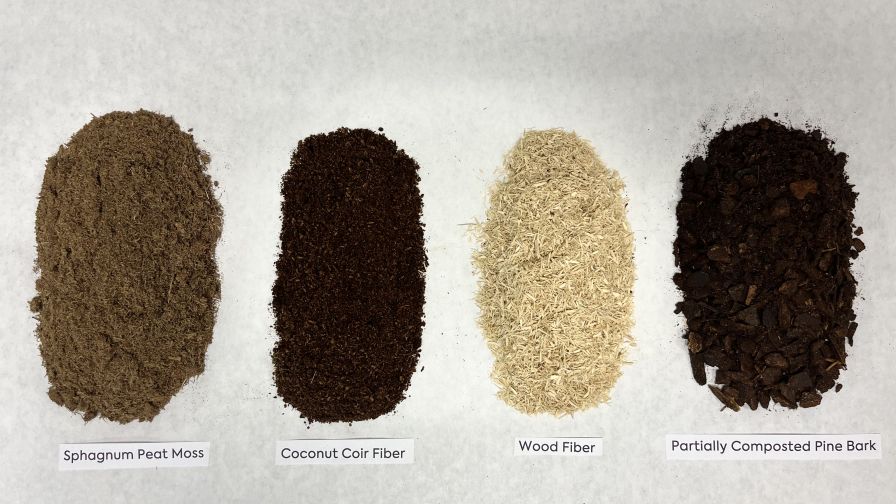
A lot of the research activity revolving around peat alternatives focuses on wood fibers and barks, examining different particle sizes, blends, and mixes. That’s all happening on a regular basis, but there’s still much to be explored there. Along with some well-known and established alternatives, such as coco or rice hulls, we’re also seeing interest in new materials, including sawdust and composted green waste.
Some of this interest in less common alternatives really ties into the question of availability. As a grower, you need substrates you can count on for performance and reliable availability. For some people that means more U.S.-produced products, more resilient to outside forces. We’re still feeling the effects of pandemic shortages and stockpiling, so many researchers follow that path of interest and demand.
Another factor driving research and interest in peat-free alternatives such as engineered substrates is cleanness. By cleanness, I mean “clean” in terms of freedom from pests and pathogens, but also in cleaner propagation and production areas, which reduce disease and pest pressures as well as labor, and simply makes the work environment healthier and more rewarding. So, while sustainability and supply chain matter, that human factor is involved in the trend away from peat products as well.
2. Functional Substrate Enhancement: Organic/Organically Derived Amendments
Another significant trend in substrate-related research revolves around amendments to improve or enhance the functionality of substrates. Focusing first on organic amendments, this is driven by a desire for precision control and tailored substrates that improve the plant growing environment and offer environmental or ecological benefits as well. Biochar and stratified media are two examples of these functional substrate enhancements.
The interest in biochar has been cyclical. Several years ago, there was a lot of interest. At one time, I experimented a lot with biochar at the propagation stage, but I did not see much benefit or effects because propagation is such a short period. That said, I do think there may be some applications for biochar as an engineered propagation substrate if it’s amended with the right ingredients.
But if you look past propagation to production, research points to many biochar benefits due to the surface area and cation exchange capacity (CEC), for example. Biochar as an amendment enhances water and nutrient retention and nutrient availability. But it also improves the microbial health of the growing media. So now we’re seeing interest in biochar increase and quite a bit of important work happening across the industry.
Hybrid substrates or stratified media, with layers of different components, is another area where important research is underway. These components may be organic or inorganic, and work to optimize water drainage and aeration, but also to capture nutrient runoff. Some of these additives may act as binders that could bind, for example, phosphorus to avoid phosphorus runoff that could be detrimental to the environment. I expect to see more work in this field as well.
3. Functional Substrate Enhancement: Biological Additives
Another significant trend in substrate research and functional enhancement relates to strictly biological additives — living organisms like fungi, mycorrhizae or beneficial bacteria, for example. There is a lot of opportunity in the greenhouse industry in this area, and I’m very excited about the progress being made.
Field agriculture is ahead of us on this. There’s already been a lot of progress with biological additives or biostimulants with row crops. But in the greenhouse production environment, there is still a lot of research that needs to be done in order to see some consistent benefits with these additives. So, a lot of work is happening.
Research with these types of organisms holds huge promise for the floriculture industry. Identifying organisms that promote plant growth but also plant-protecting organisms will have far-reaching benefits. Growers will be able to naturally enhance growth and protect plants. You won’t have to overdose with fertilizers or treat with plant-protecting chemicals, such as fungicides.
Many of these naturally occurring microorganisms can improve stress tolerance. With the changing weather patterns and global warming and elevated temperatures, imagine impacting drought tolerance and significantly promoting the quality of potted and containerized bedding plants at retail and consumers’ yards. There’s so much opportunity and potential here.
Research into how we can enhance substrate functionality through these plant biostimulants — whether growth-promoting or growth-regulating or plant-protecting organisms — is some of the most exciting and important work being done right now.
Editor’s note: For the remaining two growing media tools and trends, read the full article on GreenhouseGrower.com.