Vegpro Bets Big on Greenhouses: Inside the Expansion of Canada’s Top Salad Grower
 October 9, 2025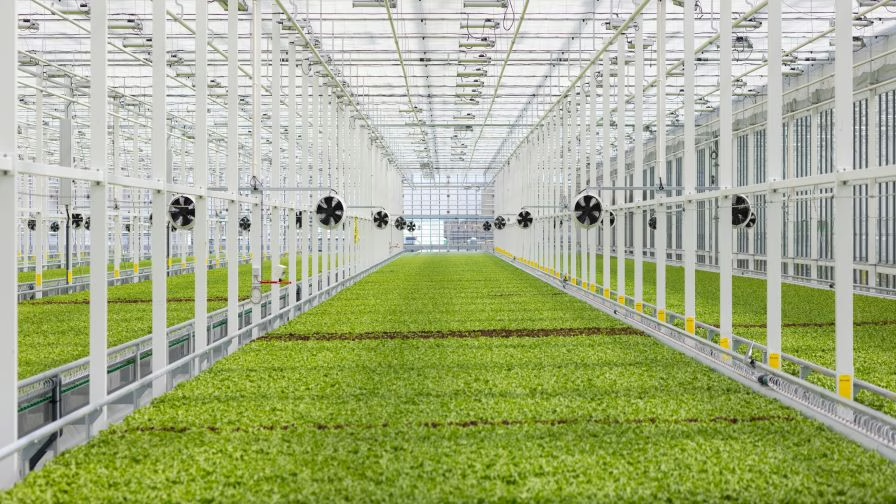
The established field lettuce grower launched into the CEA space with a greenhouse in Quebec. | Photo courtesy of Vegpro
At the end of April 2025, Vegpro, a Canadian heavyweight in field-grown lettuces and vegetables, officially launched its expansion into the CEA space with a 5.2-hectare greenhouse in Sherrington, Quebec. The $135 million investment is the first step in Vegpro’s plan to operate as a hybrid grower, a move that CEO Anthony Fantin says has been a long time in the making.

Anthony Fantin, CEO of Vegpro. | Photo courtesy of Vegpro
“About eight years ago, we started investigating indoor growing, and at that point we were looking at vertical,” he says. “We were looking to do a better head of lettuce indoors.”
The Sherrington greenhouse is a high-tech facility built in partnership with Harnois Greenhouses, capable of producing 7.8 million pounds of fresh lettuce and vegetables year-round annually. Production is built on a hydroponic mobile gutter system from Green Automation and served by closed-loop rainwater recirculation.
The operation is currently focused on premium lettuce varieties marketed under the brand name Folia. Vegpro’s core business is its Fresh Attitude brand of field-grown greens and other vegetables, sold in thousands of Canadian stores and in the eastern U.S. It also supplies field-grown greens to large North American players for private-label use.

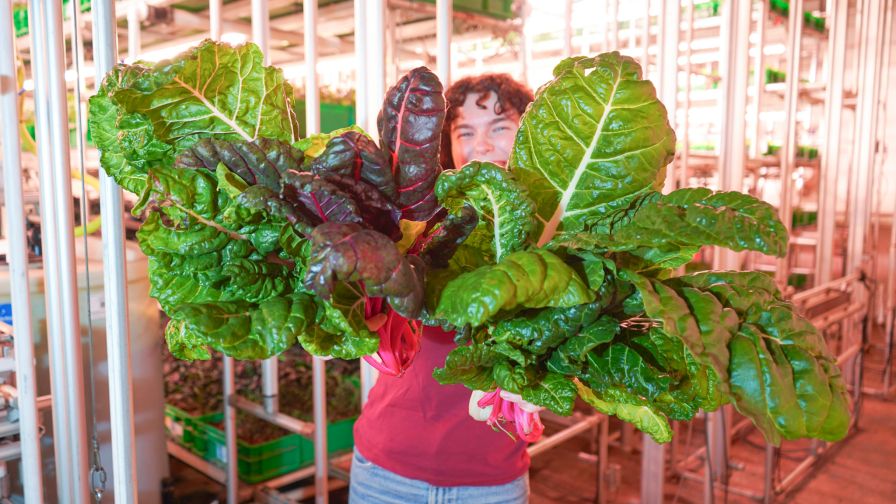

“What we grow in the greenhouse is a complement [to the larger portfolio],” Fantin says. “We use different cultivars than we use in the field, and it’s a different eating experience for sure. There’s quite an appetite for what we’re growing right now.”
CEAg World spoke with Fantin to learn more about Vegpro’s embrace of CEA and how it manages both indoor and outdoor operations on such a large scale.
CEAg World: Vegpro is one of the largest vegetable growers in Canada, with significant field operations in Quebec and British Columbia, as well as in Florida for winter production. What drove the decision to invest heavily in indoor methods?
Fantin: With Mother Nature, it’s never exactly right for agriculture. And the climate is changing quite a bit; we’re getting a lot more tropical weather up here in the Northeast than we’re used to.
At that point [eight years ago], vertical growing was really big in Japan, and so we monitored the industry, doing the math and getting into a lot of meetings and seminars. We came to the conclusion that we needed something highly automated with not too many people, and with technology that enables us to control everything really, really well.
What made you pivot from vertical farming to greenhouses?
We started talking about vertical farming because it was really sexy. It was a curiosity. In Canada, the Leamington area already had a tremendous amount of greenhouses, so we were in tune with what could be grown in a greenhouse. But vertical growing was sexy.
As we started investigating it, my main worry was that if something goes wrong inside the building, how does that translate to the rest of the crop? What kind of mechanical engineering do we need [to protect it]? We started looking at the costs.
It made sense for countries that don’t have a lot of space, like Japan, that wanted to grow close to an urban area. And they already had very, very high retail prices in place for those types of products. But very quickly, we realized that it would be quite a sticker shock [in our market] to grow our product vertically.
So we opted for the greenhouse model because we can take advantage of Mother Nature as much as possible. When there’s sun, we’re using less energy. We’re in a semi-closed environment, so whenever it’s the right temperature outside, we can take advantage of that, as well.
The Sherrington greenhouse has been open for a few months now. Were you prepared for the learning curve? What have some of the challenges been?
We’ve learned so much. It’s crazy. We’ve learned a ton about technology, about equipment interacting with other equipment to control the environment, all the moving parts.
It’s a different mindset than growing in the field, even though we’re still highly technical and technologically advanced in the field. The greenhouse is a completely different world. We’ve had to learn how to calibrate everything. What’s the right amount of CO2 and light? Temperature—when do we cool, when do we not?
So we’re still learning, but we’re learning fast. And we’ve put good resources there: Our head grower is excellent, the director of operations is excellent. The agronomist who started it all was going to retire, but he’s still on my payroll because he wants to see everything coming up. He’s outstanding. It’s like his little baby.
What are the biggest differences you’ve seen so far in managing large-scale field operations vs. greenhouse production?
The big difference, of course, is Mother Nature. Managing that in the field is a mix between technology and manpower and techniques to make sure we’re not losing the product either to disease, fungus, or pests. And that’s much more about human labor and the application of products, right?
In the greenhouse, we’re not facing Mother Nature very much but we do have the learning curve of the technology. And in an enclosed environment, if something gets in, it’s going to spread really, really quickly, and then we’re at risk.
To confront those risks, we try not to have anybody in the greenhouses themselves. So most of the scouting we do is done by drones.
While the field is the more romantic idea of farming—preparing the land, seeding, taking care of the crop—the greenhouse is more like a factory of lettuce. And we need to be as efficient as a factory. The initial investment is so expensive that we really need to be efficient to be able to provide the consumer with a product they can afford.
What are the next steps for Vegpro and CEA? Has your strategy changed at all based on what you’re learning through Sherrington?
Right now, we’re concentrating on lettuces. We’re constricted with the system we have and the type of harvesting we have. So this first phase of Sherrington is going to be geared to product we can harvest that way. And phase two will be testing other products.
We’re looking to provide our retailers in Canada with a coast-to-coast product. We have a field operation in the Okanagan [British Columbia], and while a greenhouse is very automated, we still need people. So we’ll start where we already have a base.
We also have a field-growing facility in Florida. So those are the two expansions we’re looking toward in the next two to three years.
We’re growing quite rapidly. But I don’t foresee that we’re going to be growing everything inside, because there’s still an economic advantage to growing outside. If your goal is to provide good product at a reasonable price for the consumer, growing outside is still the way to go.
This interview was edited for length and clarity.