Where to Begin? First Steps to Launching a CEA Operation
 September 19, 2025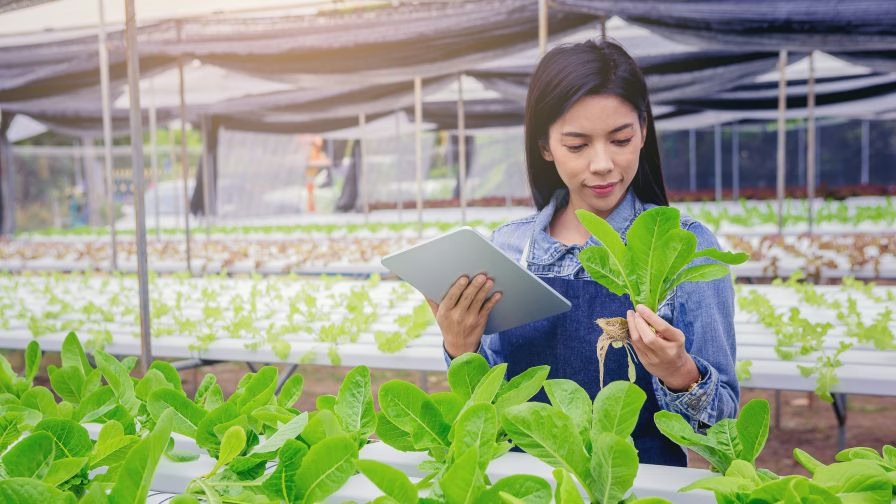
In a session at CEA Summit East, Toni Sperry of Pod Farms outlined the important steps for planning a new CEA project. | Photo: Adobe Stock
When planning a new CEA project, says Toni Sperry, president and founder of Pod Farms in Pulaski, Va., the growing system or technology choices can wait.
“The first place to start is always going to be the market. It will tell you what crops to grow. It will tell you what’s in demand. It will tell you how to distribute them, who you’re selling to, and what their requirements are for packaging and branding.”
Pod Farms is a vertical hydroponic company that develops equipment and helps farms and communities assess the viability of new projects. Sperry and her team often step in at the earliest stages to walk growers through revenue estimates, cost structures, and facility design. She spoke on the topic of planning as part of a panel titled “Budget Development for CEA Production” at the recent CEA Summit East in Danville, Va.
Sperry outlined a consistent order of operations for project planning: Define revenue potential, calculate startup and operating costs, and estimate profitability. While projections can never be exact, she said, they provide the framework for testing assumptions and avoiding costly mistakes.
Revenue, Costs, and Projections
After demand is established, growers must decide which crops to grow. “Maybe you have a select few, maybe you have one in mind,” Sperry said. “[What you grow] determines what kind of equipment you’re going to use and how you use space in your facility. It also determines the density of your crops and how much you can produce in a certain square footage.”


Facility planning comes next. What size footprint is needed for everything that goes on in your operation? Should it be a greenhouse or indoor farm? Where will crops be harvested, washed, and stored? Even handwashing stations and workflow paths matter, she said, because they determine efficiency and compliance.
Vertical or Greenhouse?
Sperry also addressed the decision point around vertical farming. “Probably the biggest reason why farmers should consider going vertical is because they have some kind of constraint on their space,” she said. Urban farms and small-footprint operations, in particular, benefit from maximizing height. But that approach brings challenges in airflow, heat, and lighting.
Height also influences labor and automation. “If you’re going to be less than 8 feet high, you may not need automation,” she recommended. “But if you’re going to go above that, you should highly consider automation.”
To illustrate how design choices affect the bottom line, Sperry described a small community greenhouse project Pod Farms supported. Her team modeled multiple floor plan options with different equipment configurations.
Just by shifting where equipment was placed or how lights were arranged, she explained, growers could see the potential to increase turn rates to generate more profit.
Finally, Sperry reminded growers not to overlook staffing, benefits, insurance, and utilities. Electricity costs, in particular, can be difficult to estimate but have a major impact on profitability.
“All of those decisions are really important to make sure that you have a profitable business,” she concluded.