How Local Bounti Is Rebuilding Toward Profitability
 August 25, 2025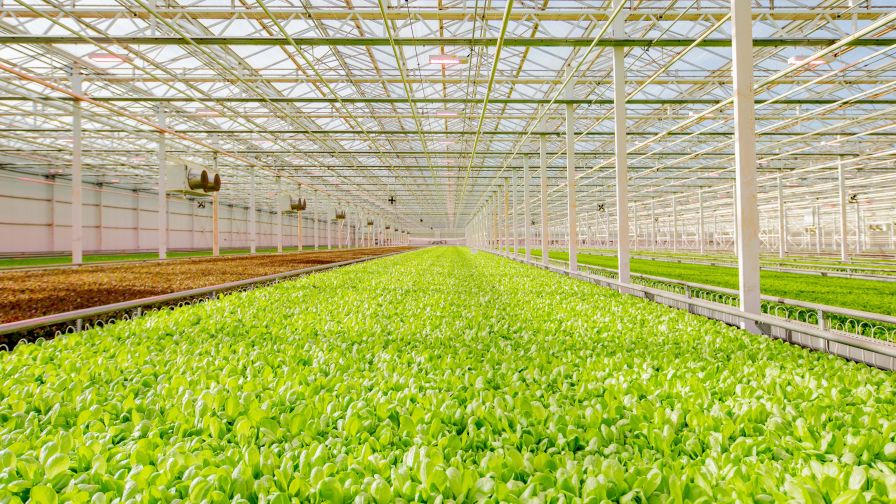
We sat down with Local Bounti CEO Kathy Valiasek to talk about the company’s past troubles and her team’s strategy for success going forward. | Photo courtesy of Local Bounti
When indoor farming company Local Bounti released its Q1 2025 results in the spring, it was a nice ray of positivity for the CEA industry: The greens grower had secured $25 million in new funding, increased sales by 38%, and restructured $197 million’ worth of debt. That progress, said Local Bounti president, CEO, and CFO Kathleen Valiasek at the time, would set the stage for positive adjusted EBITDA in Q3.
The Q2 2025 earnings results, just released, push that benchmark into early 2026, but numbers are still moving in the right direction with modest revenue gains, further cost reductions, and increased retail interest. “Our path to profitability is inherently tied to our retail partners as we scale alongside their product rollout and store reset timelines,” Valiasek reported.
Like many high-profile CEA stories, Local Bounti has had a bumpy path on the way to profitability. CEAg World recently sat down with Valiasek to talk about the company’s hybrid approach to indoor growing, its past troubles, and her team’s strategy for success going forward.
The Hybrid Growing Approach
Local Bounti entered the CEA space in 2018 (during the CEA boom) armed with a proprietary tech solution called Stack & Flow.
“A vertical farm has high yields but high capital expenditures and operating expenses, which make it difficult to turn a profit,” Valiasek says. “On the flip side, greenhouse production has low CapEx and OpEx but low yields. Our founders created a system that would provide the best of both worlds.”

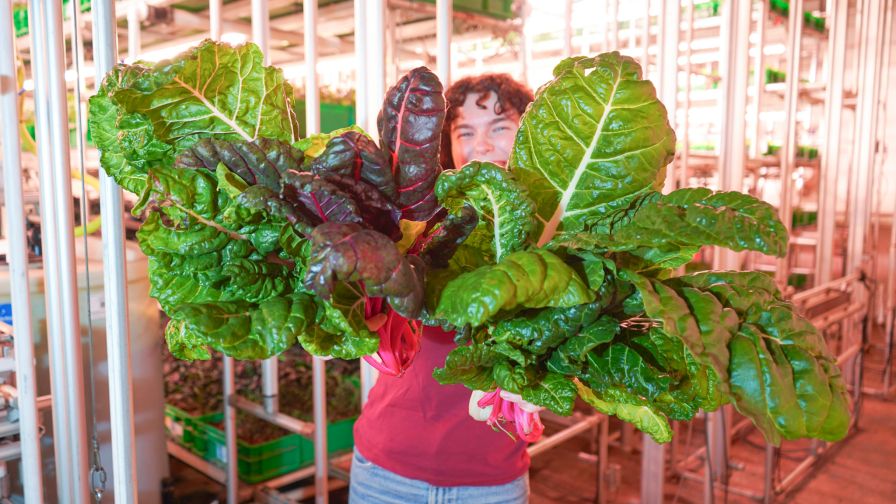

With the Stack & Flow production model, a small section of each facility is dedicated to growing vertically (“stack”) while the remaining space grows horizontally in a greenhouse (“flow”). Growers use the vertical space to germinate plants to a certain size, then transplant them into the greenhouse to complete the growth cycle more cost-effectively. According to the company, this method can triple the output of a traditional greenhouse.
The model attracted strong investor interest early on. In 2021, Local Bounti became a publicly traded company via a SPAC (Special Purpose Acquisition Company) merger, receiving a valuation of $1.1 billion. But the company began scaling before proving the long-term profitability of its hybrid system.
To meet expectations tied to that valuation, Local Bounti quickly expanded. It began constructing new facilities in Georgia, Washington, and Texas and acquired the indoor ag company Hollandia Produce for approximately $125 million. “The biggest pieces of our debt were building the facilities and acquiring a business with 10,000 retail doors,” Valiasek says.
In 2022—the company’s first full year as public—Local Bounti reported just $19.5 million in revenue. The core issue: It scaled too quickly, before validating Stack & Flow’s profitability at scale.
But performance has improved steadily over the past couple of years. Revenues grew to $27.6 million in 2023 and reached $38.1 million in 2024. Continued gains are expected through 2025 as the company ramps up output at its newer facilities.
Earning Back Investor Trust
The company’s increased capacity drove its uptick in sales at the end of 2024. Its established customers in California, most notably grocery store chains Walmart and Albertsons, started buying from its facilities in Washington and Texas to supply their retail locations in those states.
“Pent-up demand and customers wanting our product really drove our sales increase,” Valiasek says. “We knew that if we built these facilities, people would come.”
Local Bounti’s slow and steady progress hasn’t gone unnoticed. One of its biggest investors, global ag giant Cargill, strengthened its financial support in March 2025. Local Bounti also received $25 million in new capital from another investor. “Between the three of us, we can pay off the debt over a 10-year term and we lowered the interest rate to 6%, which is half of what it was originally,” Valiasek says. Just this month, she adds, Local Bounti secured an additional $10 million from an existing investor through a convertible note while simultaneously reducing its debt by $10 million.
If the company reaches the milestone of positive adjusted EBITDA in Q1 2026, that may further strengthen investor trust and the viability of the Stack & Flow system as a business model.
Forging Ahead
In addition to ramping up production and expanding operations, Local Bounti plans to diversify its product offerings beyond leafy greens to meet customer demand in the different regions it serves.
Anticipating that the company’s six facilities will be running at peak efficiency, Valiasek says, “We’ll start growing herbs by the end of next year since they’re a relatively easy SKU to add on for us. We also want to get back to berries and start developing them in a fulsome way. In CEA, you must be able to offer a wide variety of products.
“What we really want is to have a distributed footprint,” she adds. “For us, that means lower food miles, more pounds of food per square foot, and more SKUs.”