Fresh Faces in CEA Spaces: Ava Forystek
 January 2, 2025
In our Fresh Faces in CEA Spaces series, we’re talking to young professionals in controlled environment agriculture (CEA) about their work and where they see the industry going in the future. CEAg World recently chatted with Ava Forystek, a Ph.D. student studying CEA at Cornell University.
CEAg World: What first interested you in horticulture, then later, CEA?
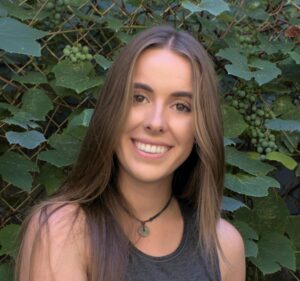
Ava Fortysek
Ava Forystek: I’ve been interested in horticulture my whole life. I grew up going to garden centers with my mom and going to Franklin Park Conservatory in Columbus, Ohio. I loved plants throughout high school, too – my bedroom was always full of plants.
I went to The Ohio State University, and they had a horticulture program. We actually had to rent a U-Haul to fit all of my house plants and bring them to my dorm. I love working with plants – I feel like every plant I work with has quirks or something interesting to teach me. I was initially drawn to ornamentals, and that has evolved into wanting to understand cropping systems and food.


CEAg World: Can you tell us more about your research over the years?
Ava Forystek: In undergrad, I did an internship with the World Food Prize in Beijing. While there, I worked on rice dwarf virus looking at auxins and auxin-signaling pathways. That was just for the summer, and it was my first research in academia. It was a really cool experience overcoming barriers with communication and learning to live on my own in another country. And I figured, if I can figure things out here with a language barrier, then I can do it anywhere.
My sophomore year, I was an intern doing plant pathology work. I was working with pesticide dosage, so that was my first glimpse into CEA and seeing what the industry was like. I did a lot of CEA work there because all the testing was in a controlled environment. That was some of my first real work in a greenhouse, and it was cool to work inside a glass house … I had so much to do in a short span of time and in such a small space.
I did a lot of internships to figure out where I wanted to be. And while I was in undergrad, I was always working in plant nurseries. I worked at a place called Strader’s as a technician who worked on plants in the greenhouse and did sales. I always needed a job, and I thought I might as well keep learning and getting experience. It really helped me navigate the world of horticulture.
I knew I liked working with specialty crops, but I always had an inkling of wanting to do CEA. I always wanted to be in the forefront of horticulture to see what I can do with plants. So, when it was time to apply for my Ph.D., I talked with Neil Mattson, Ph.D., about working with him because I was so interested in his work. It all panned out. There was a fellowship that I got on called the Grand Challenges Fellowship, and it’s a collaboration between horticulture and plant biology. My current project is optimizing teen leaf lettuce for CEA production.
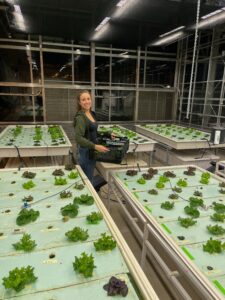
When asked about her favorite research project, Fortysek said she enjoys the deep water culture research she’s working on now.
CEAg World: Do you have a favorite project that you’ve worked on?
Ava Forystek: I really like my current project a lot … I actually just started my first trial. I have eight cultivars growing in a greenhouse right now under two different lighting conditions, and this is just to get my feet wet in CEA. So, I’m looking at how these eight different cultivars perform under two lighting conditions and create growth curves for growers to see if their lettuce is on track.
I have a deep water culture setup that I’m running on my own for the first time. I had help setting up the lab, but I’m the one who goes in there and checks the electrical conductivity (EC) and the potential of hydrogen (pH) to make sure my lettuce is happy. This is something I’ve wanted to do for pretty much my entire career.
CEAg World: What are your plans for after graduation?
Ava Forystek: I definitely want to stay working in CEA. I’ve been juggling a lot of ideas recently. I would like to be a faculty member at a university, but I’ve also been looking at being a director of a botanical garden.
I want to show horticulture to people because I feel like that’s a field most people don’t know about. People usually think I’m a gardener when I tell them I’m in CEA. They really only understand what I do when I tell them I’m a plant scientist. I want to help bridge that gap, to promote plants for people and show them what growing is all about.
CEAg World: Where do you see CEA going in the next three to five years?
Ava Forystek: I think teen leaf lettuce is going to get more focus. I also think we’re going to see more novel crops emerging in CEA, like figuring out how to grow crops that may not have done as well in the past. People will start working on them so they can be mass produced in CEA.